ClaudeBleed AI Extension Risk & CISSP Domain 3.9 Controls
May 18, 2026EPISODE SUMMARY
- Podcast: CISSP Cyber Training Podcast | Host: Shon Gerber, vCISO, CISSP | Episode: CCT 348 | Duration: 34:00
- Opening News Segment: Shon covers ClaudeBleed — a critical vulnerability discovered by LayerX Security in Anthropic's Claude AI Chrome extension. The flaw allows any malicious Chrome extension — even one with zero declared permissions — to hijack Claude and act on behalf of the user. The root cause: the extension trusts the origin (claude.ai) rather than the actual execution context, meaning any script running in the origin browser can issue privileged commands directly to Claude. Demonstrated attack outcomes include silently sending emails, exfiltrating Google Drive files, stealing private GitHub source code, and summarizing/forwarding Gmail messages — all without user interaction. LayerX disclosed the flaw to Anthropic on April 27, 2026. Anthropic released a partial patch (v1.0.70) on May 6, 2026, but researchers confirmed the underlying trust boundary flaw remains exploitable in "Act without asking" privileged mode. Shon's takeaway: AI browser agents are a rapidly expanding attack surface, and enterprise controls haven't caught up. Trust but verify — always.
- CISSP Domain/Topic: Domain 3 — Security Architecture and Engineering | Sub-domain 3.9: Design Site and Facility Security Controls
- Key Topics Table:
| Topic | Key Takeaway |
|---|---|
| ClaudeBleed Mechanics | externally_connectable trusts origin, not execution context — zero-permission extensions can hijack Claude |
| Partial Patch Risk | v1.0.70 fix is incomplete; privileged "Act without asking" mode still bypasses security checks |
| AI Agent Attack Surface | AI browser agents can perform real actions (email, file transfer, code theft) — new threat class |
| Enterprise AI Controls | Audit extension permissions, restrict AI tools in enterprise browsers, verify before trusting |
| Wiring Closets | Keep locked, properly air-conditioned, free of debris and flammables; never use as storage |
| Server Room Controls | Raised floors, cable trays, badge access, UPS, proper airflow — all critical baseline controls |
| Badge System Failures | Beep-beep systems fail in real life; tailgating and social engineering bypass them easily |
| Media & Evidence Storage | Locked room, custodian, check-in/check-out log, cameras, encryption with documented key management |
| Restricted Areas / SCIF | Limit electronics, enforce need-to-know, use mantraps; least privilege applies physically too |
| HVAC & Environmental Controls | Monitor on isolated IoT network; humidity, static, and temperature all threaten equipment |
| Fire Suppression Types | Wet pipe, dry pipe, deluge, pre-action water systems; gas systems (Halon) save equipment but displace oxygen |
| Fire Extinguisher Classes | A = combustibles, B = liquids, C = electrical, D = metals (e.g. lithium batteries) |
| Power Quality Issues | Know the terms: fault, blackout, sag, brownout, spike, surge, inrush, ground — each has different impacts |
| UPS vs. Generator | UPS enables graceful shutdown and bridges the gap; generator provides long-term backup — use both together |
- Resources Mentioned:
- 🔗 FreeCISSPQuestions.com — 360 free CISSP practice questions delivered to your inbox
- 🔗 CISSPCyberTraining.com — Free and paid CISSP training, cohort waitlist, and study blueprint
- 🔗 ReduceCyberRisk.com — Cybersecurity consulting, software sourcing, and vCISO services
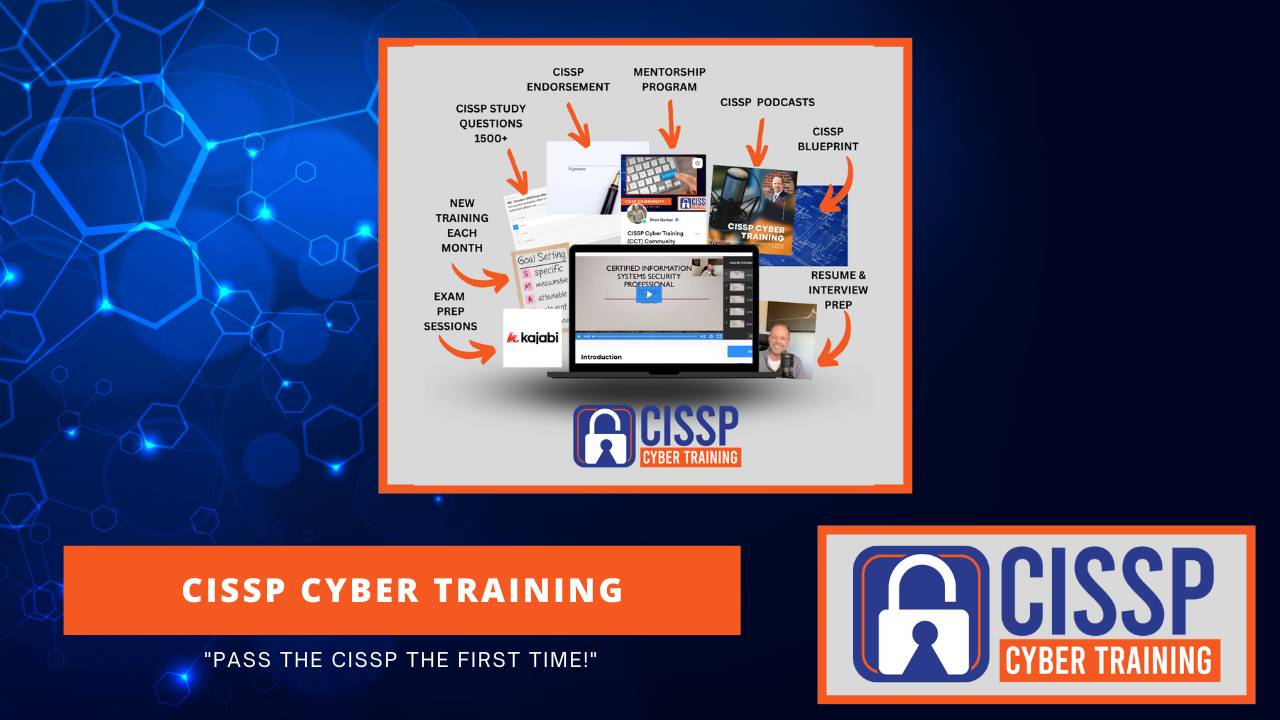
CISSP Cyber Training Academy Program!
Are you an ambitious Cybersecurity or IT professional who wants to take your career to a whole new level by achieving the CISSP Certification?
Let CISSP Cyber Training help you pass the CISSP Test the first time!